
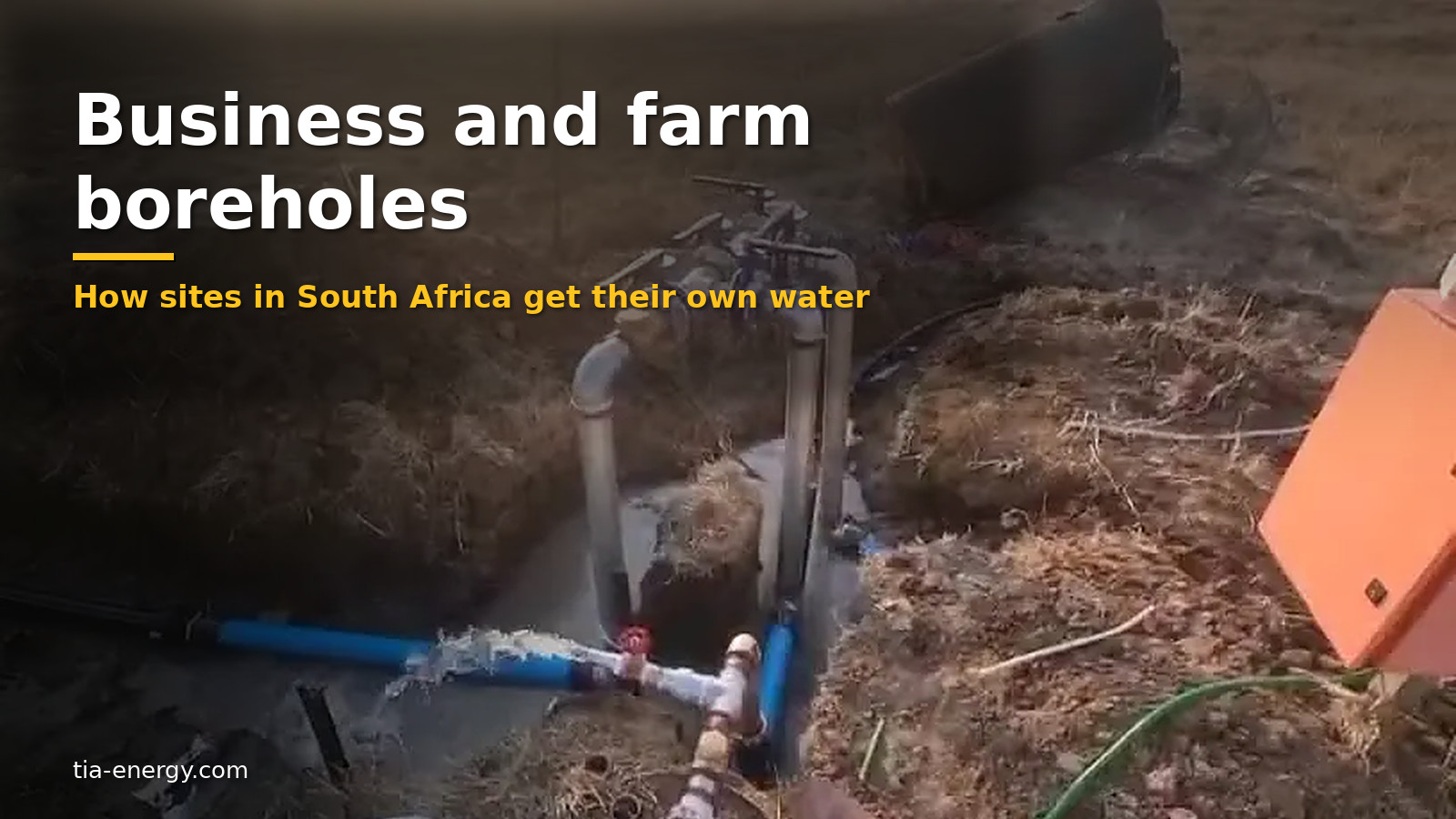
Business and Farm Boreholes in South Africa
Adam Palmer, TIA Energy. Last updated: 12 November 2026.
A borehole is a narrow hole drilled into the ground to reach groundwater. For a farm or a business, it is a water source you control on your own site, as long as the hole gives a safe yield and you follow the water-use rules.
People also search for a water borehole, a borehole well, or borehole drilling. Those terms all point to the same idea: a drilled hole, lined and fitted with a pump, that can feed tanks, irrigation, a process or a building. A "solar borehole" is the same hole, with the pump run from solar (and, where needed, batteries and storage).
TIA designs and builds borehole systems with pumps, tanks, treatment, solar and batteries for businesses and farms in South Africa. We do not drill every hole ourselves on every site, and we do not publish a TIA drilling price list. Published metre rates from one contractor are in our guide to borehole installation.
When does a borehole help a business or a farm?
A borehole can make sense when:
- You need water for irrigation, livestock, washing, a process or a site that municipal supply cannot reliably cover.
- Municipal water is expensive at the volumes you use, or supply is interrupted. Johannesburg Water, for example, has Level 1 water restrictions in force from 1 September 2026 to 31 March 2027, and on 29 October 2026 it said its systems were severely constrained, with low pressure, intermittent supply and prolonged outages in several areas.
- You already run a diesel pump or a generator to move water, and the fuel bill is hard to plan for.
A borehole is not a shortcut. Some holes are dry or weak. Water quality varies. You may need treatment before the water can be used. And a business almost never falls under the simplest household exemption in the National Water Act. The legal path is covered below and in our licence guide.
Horizontal drilling and specialist borehole machinery are a different class of work from a standard vertical water borehole. This article is about a normal water borehole for a farm or a commercial site, not about horizontal bores.
How does a business borehole system work?
The system has a few parts that must be designed together:
- The hole and the casing.
- A pump sized to the tested yield and the head. See borehole pump prices and sizing.
- Storage, usually a tank or a dam, so the pump can rest and you still have water.
- Optional treatment, if the test shows it is needed. See commercial water treatment plants.
- Power: the grid, diesel, solar, or solar plus batteries.
On TIA's Heilbron site in the Free State, two borehole pumps run from one solar array: just over 8,000 litres an hour from the first, and 25,000 litres an hour from a 7.5 kW second pump that runs fully on solar. On the Thabazimbi site in Limpopo, an 80 metre borehole pump sends about 5,500 litres an hour to a homestead 2 kilometres away. That Thabazimbi job is listed as a borehole pump project, not as a solar pump, on our projects page.
Honey Crest Mall in Randpark Ridge uses solar plus batteries, and a Greenside Johannesburg business uses solar. Those jobs show how TIA builds power for commercial sites. They are not borehole case studies.
What are the water-use rules?
This is general guidance, not legal advice. Confirm your site with the Department of Water and Sanitation (DWS) or a registered hydrogeologist.
Taking water from a borehole for irrigation, livestock, industrial use or similar purposes is a Section 21(a) water use under the National Water Act. According to DWS:
- Schedule 1 covers reasonable household use, small gardening that is not commercial, and watering livestock that graze on the land (not feedlots). Users in this category can start without first informing the Department.
- General Authorisation can cover some commercial uses within gazetted limits, but you must register before you use the water.
- A water use licence is needed if the use is not allowed under Schedule 1 or a General Authorisation.
The current General Authorisation for these takes was published in Government Gazette 49833, Notice 4167 of 8 December 2023. The limits depend on where the property sits. The power source (grid, diesel or solar) does not change the water-use test.
What does it cost to run the borehole?
The hole itself does not have a running cost. The pump does. If it runs on the grid, you pay the tariff. Eskom prices for direct customers rose by 8.76% from 1 April 2026, and municipalities saw a 9.01% average increase from 1 July 2026 (NERSA). If it runs on diesel, official Gauteng wholesale prices from 4 November 2026 are R30.86 a litre for 0.05% sulphur diesel and R31.60 a litre for 0.005% sulphur diesel (CEF). Those are wholesale prices, not the pump price, and a temporary levy cut ends on 1 December 2026.
Solar can run the pump in daylight and fill storage. Batteries help for a short night load. That is usually how a "solar borehole" is built: the hole stays the same, and the power and storage change the running cost.
If your business owns a qualifying solar system and uses it in its trade, Section 12B may allow a deduction. Confirm this with your tax practitioner, including how batteries are treated. See our Section 12B guide.
Frequently asked questions
What is a borehole?
A borehole is a narrow hole drilled to reach groundwater. Once it is cased and fitted with a pump, it can supply a tank, a farm or a business, if the yield and the water quality are right, and if the use is authorised.
Does a farm or business borehole need a licence?
Often you must at least register the use, and some sites need a water use licence. Schedule 1 is aimed at reasonable household use and livestock grazing on the land, not commercial irrigation, feedlots or industry. Read our licence guide and confirm with DWS or a hydrogeologist.
What is a solar borehole?
It is a borehole whose pump runs on solar power. The water-use rules are the same. Storage and, where needed, batteries cover use when the sun is down.
Will a borehole solve a water shortage for my business?
It can, if the hole gives enough water of usable quality, and if you may lawfully take it. It is not a guarantee. You still need storage, a power plan, and often treatment. See our guide to backup water for business.
See if a borehole fits your farm or business
If you have a site, a water need in litres a day, and a record of diesel or grid use, we can look at the hole, the pump, storage, solar and batteries. Start on our services page, or send the details through our contact page.
Sources
- DWS e-WULAAS, water use authorisation overview: https://www.dws.gov.za/ewulaas/WUA.aspx
- DWS Water Use Authorisations brochure (2025): https://ewulaas.dws.gov.za/ewulaas/docs/WaterUseAuthorisationBrochure2025.pdf
- Government Gazette 49833, Notice 4167 of 8 December 2023 (General Authorisation): https://ewulaas.dws.gov.za/ewulaas/docs/Gazette49833_No4167_2023.pdf
- Johannesburg Water, Level 1 restrictions, 15 September 2026: https://www.johannesburgwater.co.za/blog/2026/09/15/level-1-water-restrictions-are-here-lets-make-every-drop-count/
- Johannesburg Water, constrained systems, 29 October 2026: https://www.johannesburgwater.co.za/blog/2026/10/29/johannesburg-water-implements-urgent-interventions-to-stabilise-severely-constrained-systems/
- CEF press release, wholesale diesel from 4 November 2026: https://cefgroup.co.za/wp-content/uploads/2026/11/Press-Release-30-October-2026-Change-04-November-2026.pdf
- NERSA ERTSA media statement (8.76% / 9.01%): https://www.nersa.org.za/files/files/2026/03/MediaStatement-NERSAapprovesEskomRetailTariffsandStructuralAdjustmentapplicationfor2026-27.pdf
- Live TIA projects page: https://tia-energy.com/projects

