
Heat Pumps vs Solar Geysers for Business
Adam Palmer, TIA Energy. Last updated: 12 November 2026.
A hotel kitchen, a guesthouse, a staff change room, a farm lodge or a process wash-down all spend real money heating water. The usual starting point is a bank of electric element geysers, billed at the full tariff for every unit of heat. A heat pump or a solar geyser can cut that running cost. The right choice depends on when you need the hot water, how much roof or plant space you have, and what you pay per kWh.
TIA Energy designs commercial solar and battery systems. We do not sell heat pumps or solar geyser kits as a retail shop. This page compares running cost against tariffs, then shows how solar PV and batteries can cut the electricity that a heat pump or a backup element still uses.
What is the difference?
An electric element geyser turns almost all of its electricity into heat. If you use 1 kWh of electricity, you get about 1 kWh of heat. Every unit is billed at your tariff.
A heat pump moves heat from the air into the water. It still uses electricity, but a well-specified unit delivers more heat than the electricity it draws. That ratio is the coefficient of performance, or COP, on the datasheet. We did not find a published COP on the ITS commercial list page cited below, so this article does not claim a COP for those models. Confirm the datasheet for the unit you buy. A common design illustration is a COP of 3, meaning 1 kWh of electricity delivers about 3 kWh of heat. That illustration is labelled as such, not as a tested result for a named unit. Ask the supplier for the tested COP of the specific model you are buying.
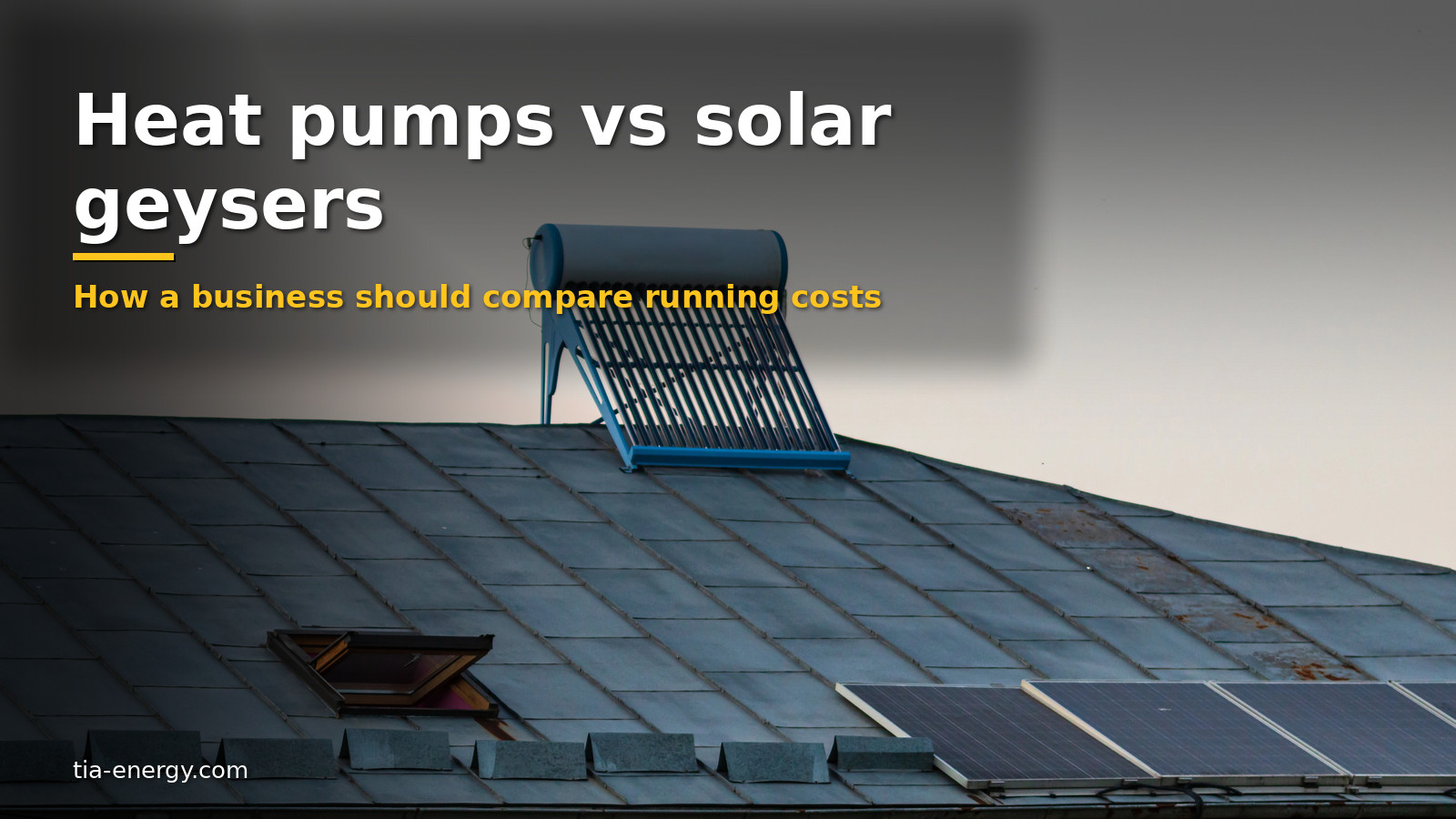
A solar geyser, in the thermal sense, uses collectors on the roof to heat water directly. It needs sun, a storage tank, and usually an electric element as backup on cloudy days or at night. A different product, sometimes also called a "solar geyser", is a PV panel that powers the existing element through a controller. Those are not the same system. This page treats thermal collectors and heat pumps as the two main alternatives to a plain element, and treats solar PV plus batteries as the way to power either.
Heat pumps can run on a cloudy day, and they need less roof area than a large collector field, but they still draw electricity. Thermal solar geysers use less electricity when the sun is on the collectors, but they need roof or ground space, and the backup element still sits on your tariff.
Cited supply prices, not installed project prices
Heat pump supply prices from ITS Solar's commercial list, fetched 11 November 2026. The page shows a list price and an EFT discounted price. VAT is not clearly stated on that page, so confirm it with the supplier. Some smaller units are marked with free delivery on that page:
- 11 kW: R32,254 list, R25,995 EFT.
- 22 kW: R48,569 list, R38,995 EFT.
- 50 kW: R150,792 list, R119,000 EFT.
- 100 kW: R301,584 list, R238,000 EFT.
- 150 kW: R452,376 list, R357,000 EFT.
- 200 kW: R603,168 list, R476,000 EFT.
Source: ITS Solar commercial heat pumps. These are equipment prices, not installed system prices. Tanks, pipework, electrical work, a certificate of compliance and cranage are extra.
Solar thermal collector supply prices from the same supplier's solar water heating list, fetched 11 November 2026, also with an EFT price, VAT not clearly stated, so confirm it with the supplier:
- ITS 10-tube collector: R6,797 list, R4,975 EFT.
- ITS 15-tube collector: R9,763 list, R7,315 EFT.
- ITS 20-tube collector: R12,112 list, R9,655 EFT.
- ITS 2 m2 high-efficiency collector: R6,797 list, R3,995 EFT.
Source: ITS Solar water heating. These are collectors only, not a complete commercial solar geyser with tanks and installation. We have not listed a complete installed solar geyser price for a business, because we did not have a confirmed installed figure. We did not use third-party blog ranges.
A business with high daily demand will often need several collectors, a large storage tank, or a heat pump sized in the tens of kW, plus a second unit if you cannot afford a shutdown. Ask for a duty in litres a day and a peak hour, not a "best heat pump" label.
Running cost against the tariff
Electricity tariffs have risen. Eskom prices for direct customers were up 8.76% from 1 April 2026, and municipalities saw a 9.01% average increase from 1 July 2026 (NERSA). Your cents per kWh are on the invoice. As one published municipal example, NERSA's 2026/27 recommended energy charge for City of Tshwane small single-phase conventional commercial supplies is 401.80 c/kWh (NERSA, City of Tshwane reasons for decision, July 2026). Confirm the line on your own bill. A site outside Tshwane must use its own rate.
Illustration only, using 401.80 c/kWh and a COP of 3 that you must confirm on the datasheet:
- Element geyser: about 401.80 cents of electricity for each kWh of heat.
- Heat pump at COP 3: about 134 cents of electricity for each kWh of heat (401.80 divided by 3).
- Thermal solar geyser in good sun: the collector heat is not bought from the grid; the backup element, when it runs, is still at 401.80 cents per kWh of heat.
If your night or early morning hot-water peak is large, a thermal solar geyser will use the element unless you have stored enough hot water. A heat pump will still draw electricity at that hour, at the tariff then in force, unless solar PV and batteries are there to cover it.
Where solar PV and batteries fit
Solar PV can run a heat pump in the day, or cover the backup element of a solar geyser, or preheat storage before the evening peak. Batteries can move midday solar into a late wash, a kitchen peak or a morning shower block. Without batteries, a night-time heat pump or element still buys grid units at the full tariff.
If you buy a qualifying generation system, ask whether Section 12B may apply, and take that to your tax practitioner (SARS IT39). Whether a heat pump or a thermal solar geyser qualifies is a tax question, not a claim we make here. Confirm the tax treatment with your tax practitioner.
Honey Crest Mall in Randpark Ridge uses solar plus batteries. A Greenside Johannesburg business uses solar. Those TIA jobs are site power examples, not heat-pump or solar-geyser case studies.
Frequently asked questions
What are heat pump prices in South Africa for a business?
Cited ITS Solar supply prices on 11 November 2026 start at R32,254 list (R25,995 EFT) for an 11 kW commercial unit, and rise to R150,792 list (R119,000 EFT) at 50 kW, VAT not clearly stated. Installation, tanks and electrical work are extra.
Is a heat pump better than a solar geyser for a business?
It depends on when you need hot water and how much roof you have. A heat pump can run without sun, but it uses electricity. A thermal solar geyser uses less electricity in good sun, but needs collector space and still has an element for backup. Compare both against your tariff and your daily litres.
Do I need batteries as well?
If much of your hot water is used after sunset, or on a peak tariff, batteries plus solar PV can cut the units a heat pump or a backup element would otherwise buy from the grid.
Does TIA install heat pumps?
TIA designs solar and battery systems that can power site loads, including pumps and heating equipment. For a heat pump or solar geyser unit, use a specialist supplier, and let the power plan be designed with the rest of the site.
Compare hot water on your tariff, then add the power plan
If you can share 12 months of electricity invoices and a rough daily hot-water volume, we can look at solar PV and batteries around the heating plant you have or plan to add. Start on our services page, or send the bills through the bill check.
Sources
- ITS Solar commercial heat pumps, fetched 11 November 2026: https://itssolar.co.za/products/commercial-heat-pumps/
- ITS Solar water heating collectors, fetched 11 November 2026: https://itssolar.co.za/products/solar-water-heating/
- NERSA ERTSA media statement: https://www.nersa.org.za/files/files/2026/03/MediaStatement-NERSAapprovesEskomRetailTariffsandStructuralAdjustmentapplicationfor2026-27.pdf
- NERSA, City of Tshwane reasons for decision on tariff FY 2026-27 (401.80 c/kWh small single-phase conventional commercial): https://www.nersa.org.za/files/files/2026/07/CoTMunicipality-ReasonsforDecisionontariffFY2026-27.pdf
- SARS IT39, Section 12B: https://www.sars.gov.za/wp-content/uploads/Ops/Guides/Legal-Pub-Guide-IT39-Guide-on-the-Allowances-and-Deductions-Relating-to-Assets-Used-in-the-Generation-of-Electricity.pdf
- Live TIA projects page: https://tia-energy.com/projects

