
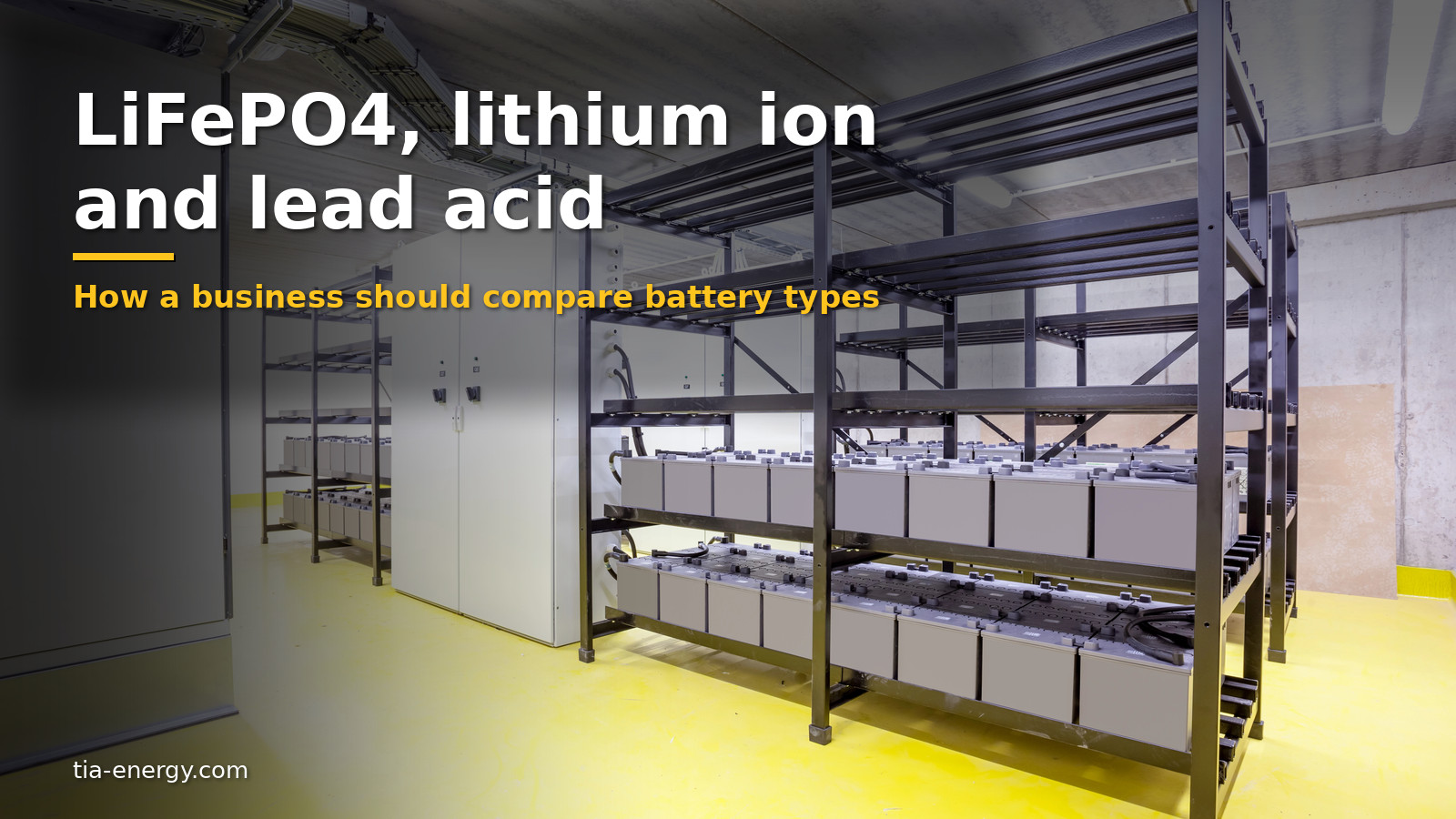
LiFePO4, Lithium Ion and Lead Acid for Business
By Adam Palmer, TIA Energy. Adam Palmer writes about solar power, energy storage and water in Africa. Last updated: 12 November 2026. This article is about batteries for business energy systems. It does not invent a cycle-life number or a TIA battery price. Where a cost range is given, it comes from GreenCape's 2026 report and is a benchmark, not a quote.
Businesses searching for "lithium ion", "LiFePO4" or "lead acid" are often trying to choose a battery for solar, backup, or both. The words are not three equal, separate families. LiFePO4 (lithium iron phosphate) is one type of lithium-ion chemistry. "Lithium ion" in a brochure may mean LiFePO4, or it may mean another lithium-ion type. Lead-acid is a different, older chemistry.
The useful choice is the one that matches the job on your tariff and your backup plan, with a clear usable size in kWh and a clear power rating in kW. A battery that cannot deliver enough power at the evening peak will not cut the expensive line on a time-of-use bill, even if the stored energy looks large on paper. Ask the designer to show both numbers against your load profile.
What the names actually mean
Lithium-ion is a family of rechargeable batteries. LiFePO4 sits inside that family. Other lithium-ion types exist as well. If a quote only says "lithium", ask which chemistry, and ask for the datasheet.
Lead-acid batteries (including sealed and flooded types) are widely used in vehicles and in some standby systems. They are a different chemistry, with different maintenance, weight and typical life. This page does not invent a cycle count for either family, because cycle life depends on the product, the temperature, and how deeply the battery is used. Ask for the manufacturer's warranty and the tested life at the depth of discharge you will actually use.
For a business, "cheapest battery" is often the wrong test. A unit that dies early, or that cannot deliver the power you need at peak time, is not cheap. The same is true of a battery that is oversized for a site with almost no evening use: you then pay for storage that your tariff does not need.
Cost benchmarks, not TIA prices
GreenCape's Renewable Energy Market Intelligence Report 2026, Table 4, gives a behind-the-meter lithium-ion battery investment cost of R4,000 to R7,000 per kilowatt-hour of capacity, and a levelised cost of storage of R3.50 to R6.50 per kWh of units stored and used. Footnote 13 of the same report uses R7.5 per watt-hour as a modelling assumption for battery energy storage. The report does not give a matching lead-acid table in the section we used, and it does not split LiFePO4 from other lithium-ion types, and it does not say whether VAT is included. Check VAT on any quote you receive.
Use those bands to sense-check a lithium battery line in a quote. Do not treat them as a TIA offer, and do not use them as a lead-acid price. If two quotes are far apart, ask whether each figure is usable kWh or nameplate kWh, and whether installation, inverters and protection are included.
How batteries earn their place on a business site
Batteries are not a decoration on a solar roof. They store energy so you can use it when the rate is high, or when you would otherwise start a diesel generator. On Eskom Megaflex, the 2026/27 winter peak energy charge for a site below 500 V and within 300 km is 739.28 c/kWh excluding VAT, against 123.20 c/kWh off-peak (Eskom Tariff Booklet 2026/2027, page 13). That gap is one reason to store midday solar or cheaper off-peak energy.
A quote should state usable kWh, not only a nominal nameplate, the power in kW, the chemistry, the warranty, and which loads will be supported. Grid-connected systems that include generation still need SSEG registration (NERSA, 2 February 2026).
TIA Energy designs commercial solar and battery systems. Honey Crest Mall in Randpark Ridge has solar plus batteries. We have not published the chemistry or the kWh size of that battery here. Greenside is published as business solar, not as a battery case study. See projects, services, and the bill check. This page is about chemistry names, not a second walkthrough of when batteries pay.
Frequently asked questions
Is LiFePO4 the same as lithium-ion?
LiFePO4 is one type of lithium-ion chemistry. It is not a completely separate family. Ask the quote to name the chemistry.
Which is better for a business, lithium-ion or lead-acid?
It depends on the product, the warranty, the usable kWh, the power you need, and the maintenance you will actually do. This page does not invent a winner or a cycle-life figure. Compare datasheets against your tariff and backup job.
How much do lithium batteries cost in South Africa?
GreenCape's 2026 report lists a lithium-ion investment cost of R4,000 to R7,000 per kWh of capacity. That range is a benchmark, not a TIA price, and it is not a lead-acid figure.
Do I need batteries if I already have solar?
If you only use power in the sun, solar may be enough for the energy work. If you have evening or peak use, or diesel backup, batteries should be in the design.
How do I get a battery sized for my site?
Send 12 months of invoices through the bill check, and say which loads must stay up during a break.

