
Solar for Office Buildings in South Africa
By Adam Palmer, TIA Energy. Adam Palmer writes about solar power, energy storage and water in Africa. Last updated: 12 November 2026. This article is for office and commercial property in South Africa. It does not invent a typical office system size or a payback period. TIA has published a business solar project in Greenside, Johannesburg, and a shopping-centre project with solar and batteries at Honey Crest Mall in Randpark Ridge. The Greenside building type is not restated here beyond "business solar", because the live projects page does not name it as an office.
Office buildings often look like a perfect solar customer: weekday daytime use, a large roof or a parkade, and a tariff that charges for every unit. That is only half the picture. Many offices also use power in the early evening, when people stay late, when cooling is still running, or when basement and security loads continue. Those hours can sit in a peak window. Solar alone does not cover them. Batteries do.
How an office bill is usually built
Start with 12 months of invoices, not with a panel count. Write down the supplier and the tariff name. A Johannesburg office, a Pretoria office and an East Rand office can sit on different metro rates. An Eskom office on Megaflex pays a winter peak of 739.28 c/kWh excluding VAT for a site below 500 V and within 300 km, against 123.20 c/kWh off-peak (Eskom Tariff Booklet 2026/2027, page 13). A small Tshwane commercial customer may now pay 401.80 or 405.80 c/kWh on the energy line (NERSA Tshwane decision, July 2026).
Common office loads in the day are lighting, computers, ventilation and cooling. After sunset you may still have lifts, parking lights, security, servers and a residual cooling load. Demand charges, where they apply, are set by the highest slice of use in the month. A short spike from heating or cooling can cost more than it looks on a simple cents-per-kWh view. The model should include those lines, not only the energy rate.
Solar on the roof, the parkade, or both
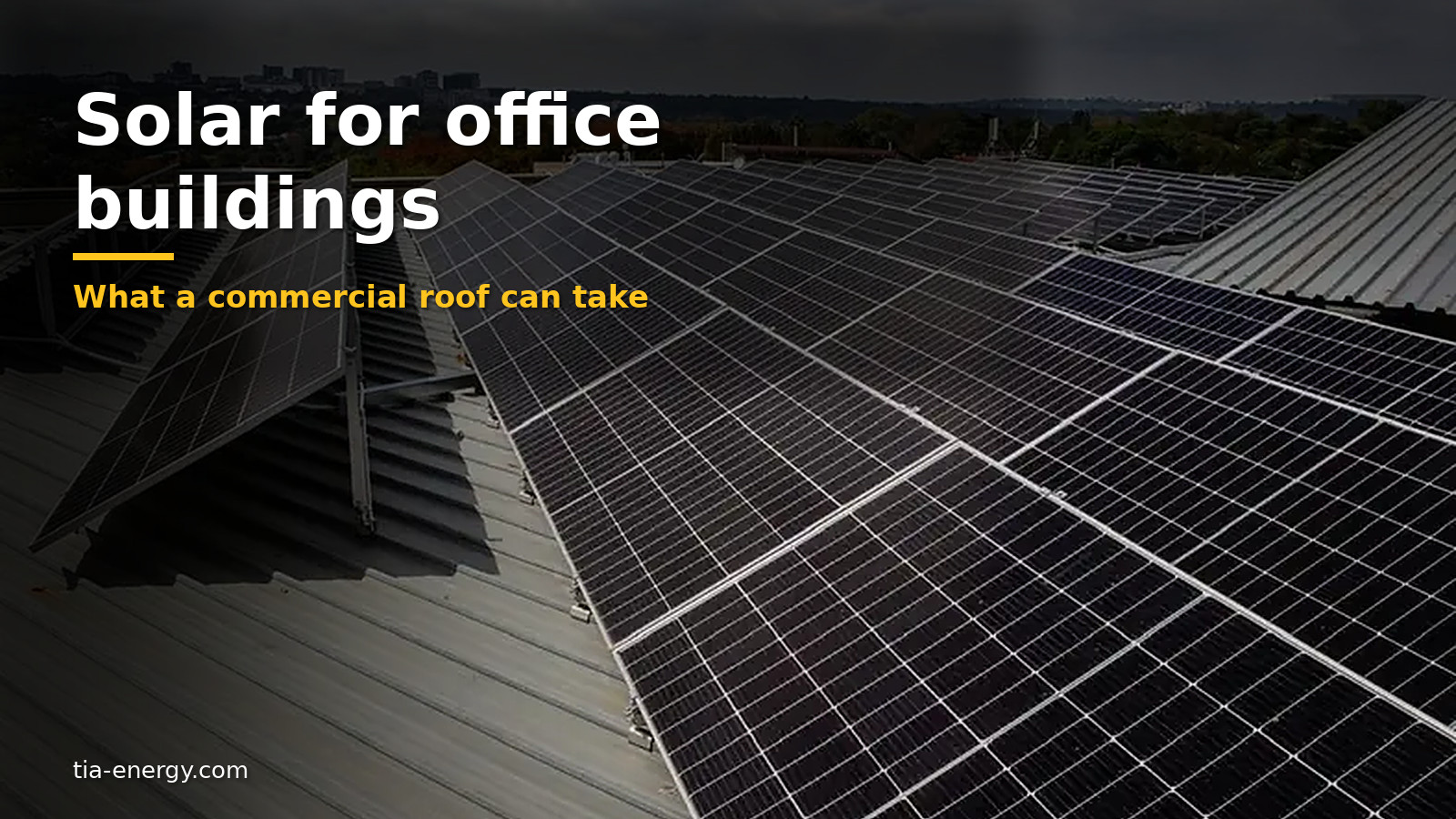
A clear roof with a sound structure is the usual first place for panels. If the roof is full, shaded, or reserved for plant, a solar carport over staff or visitor parking can add area. That is a different structure and a different cost. We do not quote a carport premium here. A solar carport is a separate design, and this page does not repeat that walkthrough.
GreenCape's 2025/26 behind-the-meter outright-purchase benchmarks for solar sit between R9.00 and R15.50 per Wp of installed capacity, depending on size (GreenCape Renewable Energy MIR 2026, Table 3). Treat those as industry benchmarks, not a TIA office price, and check whether VAT is included on any quote. Batteries are extra. Table 4 of the same report lists lithium-ion storage at R4,000 to R7,000 per kWh of capacity.
Tenanted buildings add a contract question. The owner, the tenant, or a third party may pay for the system. A power purchase agreement or a rent-to-own structure can change who owns the tax deduction. Section 12B is for the taxpayer who owns the qualifying asset and brings it into use in a trade. Confirm that with a tax practitioner (SARS IT39). See also the live PPA versus buy versus rent guide and the funding guide.
Batteries, backup and registration
Batteries in an office have two common jobs. They can move midday solar, or cheaper off-peak energy, into the evening peak. They can also keep selected loads up for a short time so you run less diesel. A server room or an access-control panel may still need its own UPS. That is a different product, and it can sit beside a building-scale battery system.
Grid-connected systems need SSEG registration. Facilities of 100 kW or less register with the supplier. Facilities above 100 kW register with NERSA (NERSA, 2 February 2026). For Johannesburg, Tshwane and Ekurhuleni, see the SSEG registration guide.
TIA Energy is based in Gauteng and designs, builds and maintains commercial solar and battery systems across South Africa. Honey Crest shows solar and batteries on a commercial property (a shopping centre). Greenside shows business solar in Johannesburg. Neither size is published here. For your office, start with the bill check and our services. The savings calculator is only a first pass.
Frequently asked questions
Is solar worth it for an office building in South Africa?
It can be, if the site has daytime use and a tariff with a meaningful energy rate. There is no single payback year in this article. The answer comes from 12 months of bills, the roof, and whether batteries are needed for evening or peak use.
Do offices need batteries, or only panels?
If the office is empty after sunset and is not on a peak tariff, solar may do most of the energy work. Many offices still have evening or demand charges, or diesel backup. Those sites should include batteries in the design.
What if I lease the building?
Ownership and tax follow the contract. The party who owns a qualifying system may have a Section 12B question. A PPA or a rental is different. Speak to your tax practitioner and read the funding and PPA guides.
Can TIA work on a multi-tenant office?
Yes, subject to access, the roof, and who signs the contract. We will still need the electricity bills for the meter we are meant to offset.
How do I start?
Send 12 months of invoices through the bill check, and tell us whether you own or lease the building.

